Wednesday, 30 November 2016

Planning: Artist image

Artist Image

Genre Ideas:
The genre of our song is Hip-pop which is a very popular genre that has particular conventions that
should be followed in order to have a successful music video with our target audience. We also decided to go against some of the traditional conventions of mainstream music videos which often attracts attention and creates huge hype. Our artist, conventionally will follow the original style of performing as does the genuine artist of 'Too Young'  - Post Malone. This is evident is most hip-pop genres where the artist tends to perform his or hers song the way our original artist does. As our target audience will be hip-pop audiences ranging from ages of 16-28 are already familiar with how their favourite music videos are like, its best to follow this traditional convention to keep loyal fans happy.

Morals and Values:
As reflected form the lyrics, the song portrays the challenges and difficulties the young man has to go
through because of his social status of a young working class male. Because of this, the artist has to turn to illegitimate means to get through the day which isn't the safest of options, yet he has to go through with it thus the tittle of the song is 'Too Young' referring to the youths that are dying too young because of this. This is also reflected from the lyrics of the song when it says 'I don't want to die too young'. 'I've been grinding for too long' is also part of the chorus which means the artist had to go through a lot more than the average person to get his average pay. Because of the struggle he goes through, a young male with a working-class background, tuning to crime as a way out, he says 'counting bands, hallelujah' which means he is grateful for the money his got. He expresses this through the visuals of his music video from having flashy cars, expensive drinks and designer clothes.

Media Perception:
The original artist form the music video can be perceived as controversial by the media because of
the lyrics of his song, evoking drugs and other illegal things. His artist image can also be perceived by the media as controversial too because he is in fact a white male with cornrows. Although he does come from a working class background, our artist fits a more stereotypical working class male because he's black and is usually represented in the media. Although the song that we chose was quite mainstream, he also has a target audience of niche audiences rather than mainstream audiences because he mixes country and rap together.


Similar Artists:

During our planning stage, other artists including 50 cent, Young Thug and Kanye West has influenced our original artist and so we decided to use them to help with our planning. Having similar music taste, Post Malone worked with the following artists which are mainstream artists in the hip-pop genre. In addition to helping us with our artist representation as the each portray their own unique style yet very similar using their own image in their music videos. Despite having each having a different artist image, they have similar morals and values as they all represent originality and sometimes may create controversy at times.

In our music video, using different urban shots where our artist will be at, we also want him to dress differently as it may reflect an existing character like these artists do in their own music video. We will make our artist dress in black hoodies and caps to reflect the youths nowadays and connote the dark side of being an individual coming from a working class background.

Some of these artists are mainstream and others are niche but together have similar target audiences. I want my artist to be portrayed in a similar from the mainstream artists by following conventional music video conventions to attract that target audience. This will allow my music video to attract more audiences through social media, radio chat shows and public appearances.

We are hoping to fulfil this type of artist image through mise en scene and cinematography. We believe if we are able to execute the right mise en scene and cinematography right for the shot then it will enhance the star image of our artist. Furthermore, this makes her more popular and interesting to watch on screen. By following theories we will also enhance this image.


Our Artist:
We have decided to use Emeka as our male artist as we believe he will be able to reflect the stereotypical aspects of the similar artists we have researched. He will be also allowed to express his own values and opinions through his persona and costume. We wanted to keep our music video similar to the original music video of our chosen artist so we're dressing him hoodies and trainers that our target audience are use to seeing. We also want him to dress in dark clothing to connote the dark side of his personality. He is also 19 years old and therefore is able to represent our target audience allowing them to relate to him. Emeka also has a performance and dancing background which means he is familiar with performing in front of a camera which ensures the artist image consistently looking confident and successful.

Link to Theory:
Goodwin: Close-up shots will be used to allow the theory of star image to come through, with these shots, it allows the audience to recongise the artist more easily for the next time they see him. Extreme close-up shots of his designer clothes to match the lyrics with visuals, mid-shots used to portray the artist clearly and allows them to establish his costume. This all helps with enhancing his star image.

Mulvey: We may consider using Mulvey's theory as it does help with attracting a bigger audience. Also considering to use female characters in the background of the music video like some of the artists I researched do.

Popular Culture: Our music video is performance based which means he will not be engaging in popular activities.

Conclusion
Overall, planning our artist representation has been extremely beneficial as we now have a clear understanding of how we want our artist to be portrayed by our audience. The audience are able to extract our artists sub-cultural morals and values just by their performance and how we represent them. In addition, this part of planning has helped me acknowledge similar artists and incorporate ideas from their music videos into ours to ensure a successful music video in the particular genre we chose. Creating the right artist image is important as the audience will be able to easily identify the artist from the offset, identifying their beliefs, values and persona which should not continuously change as it could turn turn the audience against the artist. This has also helped us link our artist to certain theories such as Goodwin and Mulvey who promote important factors within their theories.

Tuesday, 29 November 2016

Planning: Characters

Planning: Characters

Characters

Main character:

Name: Emeka

Age: 19

Ethnicity: Nigerian

Gender stereotype of role:
Emeka will take on the role of the main artist and the only character in our music video. This is because we want the audience to concentrate on him only as the song has a deep meaning behind it, we wanted to keep it quite serious and personal almost like he's telling a story about his life. This will encourage a personal relationship between the audience and him and hopefully make the music video successful.

Costume:
Emeka will have several different costumes with different shots and different locations. This is to keep the audience intrigued with the artist and not get bored because he looks the same in every shot. He will wear hoodies and tracksuits, nothing too flashy. His clothes will predominantly be of dark colours to connote his back story and that dark side of his personality.

Body language and facial expression:
He will have a relaxed body language throughout to show the audience that he is comfortable of his surroundings (his home). His facial expression may be relaxed at times but other times he will look more passionate to show the audience that his been through a lot.

Role within music video:
He will be the main character of the music video playing the artist lip syncing to the lyrics and therefore he will play an artist who has been through a lot such as the place he has come from has played a big part of who is today. He had to do illegitimate things to get where he is now, coming from a working class background, it wasn't always easy for him.

Conclusion

In conclusion, we believe that its important to be aware of who our character is and what their role is in the music video to effectively allow us to identify how he will be represented through the shots we used. This is important as every shot is portrayed differently by the audience and we must make sure they all interpret our artist in the same we visualised it. Without planning our character properly, we would be unsure of the characters role and it may also confuse the audience watching it. We also have decided to use a character with an ethnic background to meet our target audiences needs and expectations of the genre.

Monday, 28 November 2016

Planning: Locations

Location:

Intro:

Planning locations is important when making a music video as locations can be representative of many things as well as a fundamental part of the music video. The locations in a music video should fit the general narrative and meaning of the music video. An example of this is, if a shot or part of the music video is about young people living freely, a more acceptable location would be a park or somewhere there are young people, as opposed to a the inside of a house or a night club. We decided on our location while and after we created our storyboard and as we finalised our idea. We decided on having multiple locations as it is a convention in a hip hop music video, as well as all the locations being in areas which follow a general theme. The general theme is that all the locations are where young people would be seen. We carried out a questionnaire which also helped finalise decisions on locations. Questions such as "What location do you see a hip hop location set in?" Our results from the questionnaire stated that most people would see a music video set on the streets, with house,club, park and beach coming after with the least responses. Although we decided to incorporate the streets mostly as well as a field and a skate park. We considered the advantages and disadvantages of the locations as it is important to identify what problems could occur.

Chosen locations:


Conclusion:

In conclusion, we decided that using various locations has allowed us to make our music video more interesting and of a higher standard. In hip hop music videos, the locations change frequently within the video along with fast paced editing, therefore we will be doing this with our locations. The park and the use of the drama room are the least conventional for hip hop music videos but the other three are frequently seen in music videos. All of our chosen locations are somehow relevant to the music video and we are hoping these locations will be beneficial by us being able to shoot on time with no problems. We have outlined potential problems in case this does happen as we must ensure all the locations are used properly.


Saturday, 26 November 2016

Planning: Group roles

Planning: Group Roles

Group Roles
Production roles are made up of 11 key roles that are essential in a music video, this ensures that they are made successfully. These 11 production roles include the director, producer, editor, cast control, camera operator, lighting operator, print designer, photographer, storyboard organiser, location manager, costume, hair and make-up artist. We split these roles into two based on our strength and weaknesses as a pair so we were able to carry out these roles in the best way possible.

The different roles and their definitions:

Director: A director is the biggest role of them all as this role is responsible for having authority of
directing the music video. A director gives directions to the crew and cast to ensure that everyone is following the script and storyboard correctly, this also ensures that they music video comes out successfully for their target audience. A director must have good leadership skills, communication skills and organisation in order to fulfill this role adequately, they must make sure that their team members meet the right deadlines, working efficiently and making use of their time well. The director is also supported by the producer and storyboard artist by supervising them to make sure they follow the storyboard correctly. Overall, this role holds the most responsibility making the overall decisions associated with the music video.


Producer: A producer is someone who works very closely with the director by supervising the making of the music video, they also prepare and present it to the music distributor. One of their key responsibilities in ensuring that the work environment where the crew will be filming is prep for the cast to perform. The producer is also usually the first person to get involved in these projects and come up with the initial idea for the production, securing the rights, choose the screenwriter and story editing team. During the pre-production, the producer is responsible for bring the whole creative team together which includes the director, cinematographer, production designer and key cast members. Overall, the producer helps supervise the development process ensuring everything runs smoothly as how the director would like it.


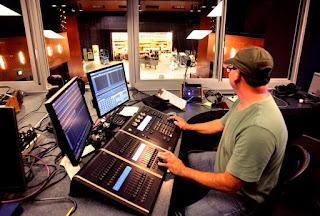
Light operator: The role of the lighting operator is responsible for creating the light and atmosphere in the music video, this is very important as each particular type of lighting connotes what is associated with each shot. For example, if the shot had negative connotations, the light operator would have to ensure that low-key lighting is used to support this. The light operator will also have meetings with the director, designers, stage manager and production manager to discuss ideas for the music video and take care of the budget and scheduling details for the production.


Location manager: A location manager takes care of finding the right and appropriate location for the music video to be shot. They must ensure that they obtain permission from the location owners, police and governmental permits to be able use the location. A location manager also works closely with the director and production designer during the pre-production to find a secure way of producing a successful visual. They are also responsible for the public relations at the locations used and ensures the crew and casts safety during the filming stage.


Camera Operator: The person who is in charge of operating the camera is responsible for maintaining the camera angles, movement and size of each shot. The camera operator will also work closely with the director, director of photography, the cast and the film crew to make technical and creative decisions together.


Editor: An editor is someone who is responsible for working with the raw footage taken and selecting the appropriate shots and then combining them together into sequences to create moving images. An editor also works creatively with the images, dialogue, pacing as well as the actors performances to effectively re-imagine and sometimes even rewrite the music video if needed. This dynamic role belongs to the editor when making a music video.


Costume, Hair and Make-up: The person who is in charge of costume, hair and makeup is responsible for creating the cast members appearances to ensure they fit with the music videos themes and genres. They also assess the makeup and hair requirements, setting up the department and prepare the makeup and hair budget schedules. This role also breaks down the script and storyboard in each scene to identify what kind of costume, hair and makeup is needed in that particular shot. Before beginning the creation of the characters appearances, they make notes on each character to ensure that they make it fit the representation.


Storyboard Organiser: A storyboard organiser is responsible for producing the images and notes of the music video in each shot by visualising the details of every scene and writing their ideas down. This makes it easier for them to improve the shot and make it look more attractive to the audience and also fitting with the conventions of the storyboard. Storyboard artists may use photos to also create visuals where photos are taken specifically for the project and then by digitally putting them together to produce a photographic representation called a photo visual.


Print Designer: A print designer uses their technical skills to arrange the style of the designs as they appear on the page, they choose the type of fonts that will be used, including size and colours to ensure that the headlines are attractive to the audience.


Photographer: The photographer is responsible for taking the photographs of something and use the photos in various ways that includes the album covers, posers, social networking sites, newspapers and magazines etc. The photographer should be someone who is skillful at holding and position the camera at the most appropriate angle to ensure that the photos come out in high quality.


Cast Control: The person in charge of cast control is someone who takes charge of the cast members by ensuring that the cast arrive on time and they are where they should be.


Who has what role and why?

Trang will be having the role of: the producer, editor, costume, hair and makeup, storyboard organiser print designer and cast control. This is because she has great communication skills which is beneficial when communicating with the director. The producer and director must work cohesively exchanging ideas and opinions to ensure that the music video comes out the way it should be. Trang is also responsible for all the creative based roles such as costume, hair and makeup as well as print designer because due to her artistic skills, she is able to visualise what is suitable for every shot and make it look most attractive. She also has the role of editing and storybaording because she knows when each shot should be introduced. With her editing skills, she is also able to edit the music video where it looks more attractive to the audience. As an organised person as well, we decided that it would be fit if she was the cast controller too.

Dillan will have the roles of: the director, light operator, location manager, camera operator and photographer. All these roles is very suitable for Dillan as he is a very hands on person, with his technical knowledge of cameras, he is given the role of handling the cameras and directing the music video. As the director, it is only fair he is also in charge of the location to fit with his ideas of what he wants to be shot. He is also responsible for the light as he is good at identifying what type of lights work well with each shot.

Conclusion: How was this beneficial?
In conclusion, this planning has been very beneficial for us as it has allowed us to identify everyone's strengths and weakness to then we are able to allocate each other in the best role suitable for us. We are also aware that particular roles hold more significance over others and therefore, we distributed them equally.  Planning this makes it easier for us to understand who will be doing what and there will also be no confusion in in the production stage.

Wednesday, 23 November 2016

Planning: Shot-list

Shot list

Our group created a shot list which we used to identify the different shots, movements and angles that we will include in our music video. This will be extremely helpful as we were able to choose various shots, angles and movements and discuss whether they would work together to make a successful and entertaining music video. It also helped us avoid repeating similar shots. When filming the music video we will keep the shot list handy to ensure we are capturing the correct shots in the right order.


Conclusion

Shot list helps our group understand what shot sizes, angles and movements we will capture in order, for each frame and for how long these shots will last. The shot list will be very useful for the director as they will know what angle and shot to have in which order, which will also prevent them from repeating shots. The editor will also find the shot list useful in post production to ensure everything is in order and all the shots make sense to make the most entertaining and appealing music video. 


Tuesday, 22 November 2016

Planning: Research into similar videos

Research into Similar Music Videos

Introduction:
We decided to analyse different music videos to identify similarities within our own music video. This also gave my group and I some new ideas that we could use to develop our idea making it more successful. We also decided to analyse videos by looking at three main factors including, content and visual style, content and visual style of the video and artist representation. This is to find similar to the videos that had these particular factors, we had to analyse the various music videos from these various genres.

Content Analysis

Video 1: Sia - Elastic Heart

Analysing this particular music video was interesting as the visuals and content of the video was unique and different to most mainstream music videos.

Themes Apparent: The particular themes that were explicitly evident to me included isolation, struggle, connection and escape. These themes also supported the particular narrative of the music video.


Lighting and Colour: There was natural lighting throughout, top lighting as well as back lighting with no added colours as I believe the artist wanted to keep a natural and innocent tone to it. Furthermore, the natural lighting makes it more realistic as the top lighting adds to the personalities of the characters that are caring and innocent to each other.


Body Language and Facial Expression of the Characters: The two characters have flexible bodies in addition to their body language throughout bend and dance to the music. This is followed by their neutral facial expressions in the beginning in which then turns into an aggressive facial expression. This creates suspense and tension for the audience especially if the narrative is not as clear to them.

Setting: The setting is a white empty white room with a large cage in the middle. This is where the two characters dance inside. The us of the cage represents imprisonment.

Iconography: Iconography in the music video includes the cage to illustrate the how the two characters that may feel trapped and the bandages the male character has wrapped around his hands to portray his struggle.

Character Representation: The characters are represented unconventionally as they are perceived by the audiences as dirty with no emotions. Instead they express their emotions through dancing as their form of communication. Characters like this are not usually mainstream and therefore, this music video is more likely to be targeted towards a niche audience.

Artist Representation: This is not evident in the music video as the artist is not present.

Editing: There was slow editing used in the beginning of the music video and fast editing gradually used towards the end of the music video. This accompanies what the characters feel within the narrative as the type of editing is used to empathise their emotions. First calm and non-expressive and then aggression.

Use of Camera Work: Panning shots are used throughout the music video to capture shots around the cage. Establishing shots were also used to allow the audience understand the type of setting the characters were in and extreme long shots and long shots were used to capture the characters when they dance together.

After analysing this music video, we identified some similarities that we also may use in our music video such as the type of editing they used to portray their emotions within the music video without any words. Moreover, this will create some type of suspense for the audience. We wanted to keep our music video clean and simple like this to keep a natural tone to it.


Artist Representation

Video 2: A$AP Rocky - L$D (LOVE, $EX, DREAMS)

Whilst analysing this music video, the bright colours and creative editing really captured my attention. Although this type of complex editing was no what I had in mind, A$AP Rocky is very similar to the artist Post Malone which makes sense why their artist representation may be similar in many ways. Originally coming from a lower class background, they portray a stereotypical individual who may be from this particular background and therefore they both may have similar morals and values.


Body Language and Facial Expression of the Artist: The artist has a neutral face throughout the music video with a calm and relaxed type of body language. This mellow type of vibe we get from him is contrasted between the creative editing and vibrant colours used throughout the music video. This is also contrasted from when he is performing, lip syncing to his song. This is when he becomes a little more active.


Costume, hair and makeup: His clothes tend to follow mainstream fashion as he has different types of outfits throughout the music video. It goes from black and white or bright colours and geometric patterns on his tee.

Interaction with Others: In this music video, he has a female companion with him which looks like they have an emotional relationship together. They accompany each other throughout the music video until the end where she disappears.

Camera work: There are many crane and panning shots that follow the artist around which is also accompanied with complex editing which gives it a trippy feel to it. There are also close-up shots of him and medium shots of him when he is with the female character.

From this analysis and from the title of the song, the music video is meant to portray an LSD trip. This is supported by the colourful edits and camera shots shown in the music video. The narrative also predominantly focuses on him and his female companion and from the title reads 'Love and Sex' which may inform the audience what that female character was to him. The similarities I found with this artist and the artist that I have chosen for my own music video is that they have similar themes within their music video that focuses on the opposite sex, money and drugs.


Structure and Artist Representation

Video 3: The Weeknd ft. Future - Low Life

Analysing this music video, the particular structure and the character representation used within this music video was similar to how I wanted my music video which was why I was interested in it.

Performance: The performance in this music video was mainly the artist performing the song. There wasn't much any other performing within the music video, this is how I want my music video. With very few things to distract the audience from the artists.


Concept/ Abstract Ideas: The artists are lip-syncing to their song with other female characters that are standing in the background to attract more audiences.

Narrative within the video: There isn't a narrative as the concept is based on performance.


Conclusion
Overall, I will be taking these ideas from these music videos. I will do this through the same use of dark coloured clothing with high and low-key lighting. This evokes suspense from the audience. Similarly to these music videos, this is what I want to achieve within my music video. This has helped me on how I can achieve a successful music video looking into some music videos that have similar factors that I want to include.

Monday, 21 November 2016

Planning: Storyboard

Storyboard

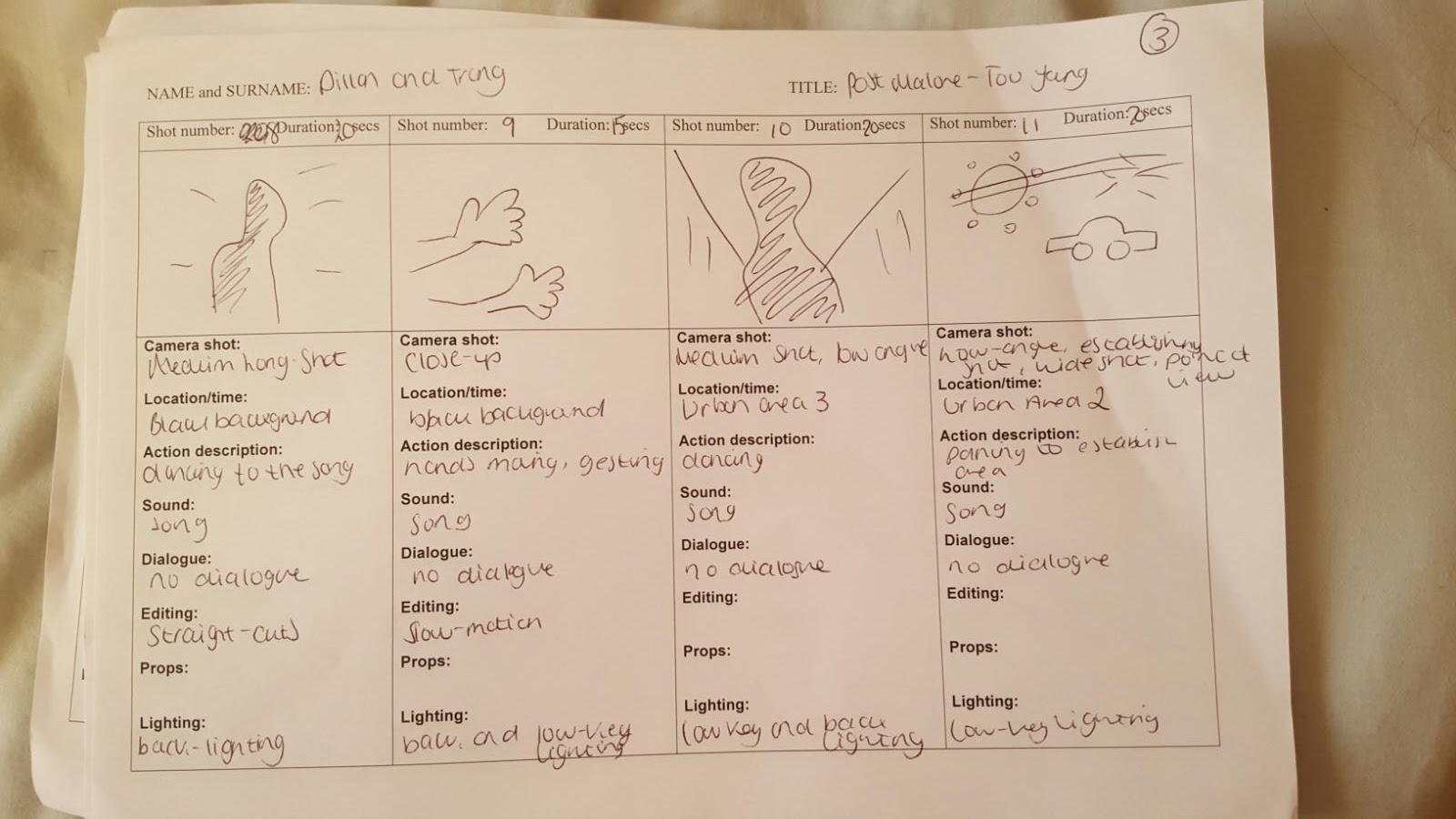
In order to film our music video, we needed to do a storyboard to understand what was going to happen in every shot. It's a graphic representation of how a moving image will unfold shot by shot, made up of illustrations or images. Each shot includes what camera shot will be used, location of the shoot, props, lighting, sound, dialogue, editing and narrative description to ensure that there is no confusion when filming. In addition, this helps filming run much smoother as everyone will know what shot to take next.
Having a storyboard for our idea is very helpful for a number of reasons, not only is there as guidance but we're able  to look closely at the narrative taking all shots into consideration, rather than identifying a brief overview. This would have not give us any insight into the details we need to look upon when creating our music video. This makes it easier to pick upon the things that need changing if its an unrealistic goal. We story boarded the entire music video and thought about all the details, giving us a clearer idea of how our music video will unfold.


Conclusion

With a story board, my partner and I are able to shoot our music video without any confusion because we know what shot we need to shoot exactly.