Thursday, 3 November 2016

Research: Star Image

What is star image?

Star image is the way an audience is represented to the audience, this is done through music videos as it can reach a mainstream and international audience. What the artist wears, behaves and how they look is considered. Artist's star image is important as it determines how successful the artist is and allows the audience to form their own opinions about the artist. It is also useful for the music industry as they can use star image for maximum financial gain.

How can music videos help boost an artist's career?

Can make artist more popular - successful music videos can enhance an artists fame and make them more appealing and generate recognition in the industry.

Artist can be shown to a mass audience - Music videos are now available on various platforms such as YouTube, Vimeo, Vevo and Apple Music. This allows the artist to be widely available globally.

Promotes the artists image - Artists are given a chance with their star image to promote themselves as unique as well as their individuality. An example of this is Lady Gaga- who is known for her outgoing and "random" outfits and costumes.

Music videos live longer than artists single - Music videos are highly unlikely to be removed unless there are severe censorship issues. Music videos are also more likely to get multiple viewings rather than a song people can get bored of and not come back to for a while.

An audience and artists relationship can grow - A relationship can be built between the artists and the audience which makes them have more appeal for the artist, usually as the audience feel they can relate to particular lyrics or narratives in the music video.

Although, music videos can also jeopardise an artists career; causing them to lose fans and mass appeal. This is due to loss of interest by the audience and lack of viewings.

Case study - Kylie Minogue 

As a class we observed how Kylie Minogue's star image developed over time due to their changed in her music videos.

1980s


  • Was a star in the Australian Soap Opera 'Neighbours'
  • General target audience was teenage girls - due to the content of her music
  • Presented herself as 'innocent' and a sweetheart through her body language and mannerisms
  • Presented young girl values and was seen as cheerful and excited 
  • Lyrics were innocent and childish   

Early 90s


  • Released her third album in 1990
  • Audience drifted to late teenage boys and girls
  • Began to intimidate young teenage girls as they were unable to relate to her
  • Appearance drastically changed - more sophisticated and glamorous
  • Generated more sexual attention from boys and admired by girls
  • Dancing in her music videos changed to heavily choreographed routines where she was the centre of attention
  • Values appealed more to the opposite sex
  • Lyrics developed into more mature and deep lyrics

Late 90s


  • Target audience drifted from teenagers to a much wider male audience as her physical appearance matured 
  • Her look became more 'sexy' and 'daring' which was seen as empowering and intimidating for audiences
  • Her values had changed as she became seen as more independent 
  • Her dance choreography changed as she began to dance alone and in more revealing outfits
  • Lyrics become more confident and daring "I've got nothin' left to hide" 
2000s


  • By now her target audience was young adults in their mid 20s
  • Her music was being produced for clubs
  • Her appearance became a lot more sexually intimidating and aggressive
  • She had more backup dancers who were all portrayed in a sexual manner
  • Her values started to suggest self confidence
  • Lyrics were becoming more and more daring - which was supported by the change in her tone

Justin Bieber

I looked into how Justin Bieber has changed as an artist as his music videos have changed and thereby influenced his star theory.

2008

Justin Bieber started his career in 2008 after being discovered by Scooter Braun, through a Youtube video. His first single "One Time" was released in May, 2009. At this time his fans were generally young girls and boys while the genre of music he was making was teen pop and R&B.


At this time he had a very iconic hairstyle of longer hair and he looked very innocent, as were his lyrics. "When I met you girl my heart went knock knock knock. Now them butterflies in my stomach won't stop stop" These lyrics are from "One Time" and although he was singing about relationships and love, it was in a very innocent manner and did not suggest anything sexual or adult.


2012

In 2012, Justin Bieber released his third studio album, Believe. This was seen as quite a departure from teen-pop and had influences of dance-pop and R&B - developing a more "mature" sound. Bieber had also started to change his physical appearance by keeping a constant shorter cut hairstyle and showing off his body more, especially arms and upper body.

His lyrics had also developed and changed as he was singing more about general teenage or young adult themes such as relationships. "If I was your boyfriend, I’d never let you go.I can take you places you ain’t never been before" This signified that he was growing as was his music and possibly his audience with him, as now his audience would be young girls to late teenagers.


2015-2016

From 2015 onwards Bieber has mainly been releasing songs in the electronic dance music and R&B acoustic genres, which was seen as a drastic change from the teen pop he used to base his music around. As Bieber grew, his audience did so too, with his target audience now ranging mainly from 16-25 year olds as his music is now more universally appealing.

His appearance also changed as he is involved in a lot more photo shoots, sporting much shorter hair than he used to as a teenager and shows off his tattoos which are all over his body. His dress sense has also changed with his outfits looking a lot more mature.


Examples of stars and their image on the audience/industry

Adele is an artist who is considered quiet as she rarely appears on tabloid newspapers and generally keeps to herself. Although when she does release albums or singles she gets immediate attention worldwide and she is regarded highly in the music industry. Her behaviour and choice of clothing show she is modest and not interested in showing off her body.


Beyonce is a hugely popular female artist who is seen as sexy, independent and empowering for women. She is known well for her body and curvaceous figure as she regularly wears tighter clothing especially at concerts and other public appearances. She is seen as a role model for female audiences as well as those in the music industry.


Miley Cyrus is seen as a controversial, young "bad girl" as she is regularly seen wearing odd outfits, sporting colourful dyed hair and is one of the few that has grown up in the industry, therefore her change has made a bigger impact especially in the wider media.


Star image: sexual reasons, political reasons, moral reasons and social reasons

Star image - Sexual

Some stars may use music videos to expose their audience or to be more open about their sexuality. Examples are Macklemore and Katy Perry who show their support for the LGBT communities in songs such as "Same Love" by Macklemore and "I Kissed a Girl" by Katy Perry.


Star image - Political

Some artists may use their fame and music videos to express their political views in different ways. This may be to give their opinions or to simply educate an audience in the way they see fit. M.I.A and Kendrick Lamar are examples of artists that use their music videos to politically educate audiences. M.I.A borders tackles issues of the refugee crisis and and shows people travelling on overcrowded ships and climbing barbed fences. Kendrick Lamar's "Alright" addresses issues of police brutality against blacks and attempts to send a positive message.


Star image - Moral

Some artists may use their reach to address audiences on their moral views. Michael Jackson's "Earth Song" focussed on environmental issues, war and animal slaughter as these views were very close to him. Realism and harsh imagery was used to evoke emotion from the audience.


Star image - Social

Certain artists may just use their music videos to promote a certain lifestyle they live due to their fame and fortune. Drake is an example of this as the majority of his music videos have alcohol and various expensive items and clothing included. This is his representation of his 'party' lifestyle and atmosphere.


Conclusion: what is the importance of star image? how do  you plan to represent your star?

Star image is very important to an artist as it allows the audience to use what they see of the artists to come up with opinions on them. I will be presenting my artist in a stereotypical form as I will most likely be creating a music video for the Rap/Hip-hop genre, depending on the song I choose, my artist may touch on issues with society and possibly moral and political issues. I will also do this by following a narrative with my music video, possibly one that will represent the artist's personality and society he or she lives in. My artist will also represent continuity with their star image, unlike Justin Bieber or Kylie Minogue  who went through dramatic and drastic changes, my artist should look as if they have already found themselves as a performer so it is easier for the audience to relate and identify with them.

Wednesday, 2 November 2016

Research: Hebdige's Subcultures

What are subcultures?

Subcultures are a larger group within a culture that differentiate themselves from a larger parent culture. They share certain norms and values and tend to differ from those that are mainstream. These differences include, interests, behaviours or beliefs, religion, ethnicity and social or economic status. Examples of subcultures include; cosplayers, who wear costumes and fashion accessories that represent specific fictional characters, punk, which is a subculture that centres on punk rock music who also have various ideologies, fashion and forms of expression. Skinheads are also a part of a subculture that originated amongst working class young men in London in the 1960s.

Cosplayers at a convention
Punk
Skinheads


How are they evident in the music industry?

Subcultures are evident in the music industry as certain genres relate to some subcultures, rock, pop, hip hop and reggae are all music genres that are very likely to have a specific audience that may follow a particular subculture. Punk is one of the most well known subcultures that was created by a musical genre, the punk subculture formed in the US and the UK in the mid 1970s, it is heavily centered around punk rock music. They are known for their anti-establishment ideals and beliefs in independent freedoms, they are also known for their fashion. They fashion includes body modifications such as tattoos, spikes, mohawks and wearing black clothing. Hipsters are a subculture that are known for the associations with certain trends and indie genre music, some fashion trends include, growing out mustaches, flannel shirts and trucker hats. Hippies are a a very popular subculture in relation to the hippie movement. At the same time as the hippie movement there was a cultural revolution called the sexual revolution, hippies participated in this as they are characterised as valuing "free love". Hippies are associated with the psychedelic rock genre, their fashion included bell-bottom jeans, vests and headscarves. They also had a political agenda which was expressed through their music, promoting peace, homosexual rights, feminism and other aspects of civil rights.

Hipsters


Hippies

Examples of artists that are associated with subcultures include:


  • ACDC
  • Sex Pistols
  • Pink Floyd
  • Green Day
  • Red Hot Chilli Peppers
  • Arctic Monkeys
  • Bastille
  • blink-182
  • My Chemical Romance
These bands are all associated with subcultures as they all have very particular norms and values and their target audience are very selective and can relate to the artist.

What did McCracken say?

McCracken stated the postmodern world is full of diversity, dynamism and creativity. This rejects the idea that all subcultures come from one culture, because they grow at different times and places via different people. An example of this is that teddy-boys do not exist anymore, but bikers are still a subculture. McCracken also criticises the Birmingham School as it assumes all subcultures come from one mainstream culture, he disagrees that subcultures are merely a rejection in response to mainstream culture.


What did Hebdige say?

Hebdige claims that consumption is an active process by which different groups and audience read the same cultural product. Many groups resist the mainstream as subcultures are little cultures doing the same thing of resistance. Subculture music began in the post war era of the 50s and 60s, there was social cohesion at the time and everyone had the freedom to do what they wanted and were more open about expressing themselves. Hebdige claims mass culture does not exist, different individuals enjoy media products for different reasons although this does contradict his argument of subcultures existing due to popular resistance.

Subcultures and historical times in relation to music

It can be argued that cultural music tastes varied depending on the context of the era it was in, as well as the structure of economic and political change at the time.

1950s - Rock n Rollers, Beatniks and Teddy Boys
1960s - Surfers, Mods, Hippies and Bikers
1970s - Skinheads, Punk, funksters and Rastas
1980s - Heavy metal, hip-hop, goth and rave
1990s and beyond - Fashion and music have a correlation where what you enjoy is what social group you are in.

How does the industry now target audiences?

The music industry can target large audiences with televised singing competitions such as X Factor or The Voice. These programmes are used to identify gaps in the market and can change the lives completely of "ordinary" people as they make them worldwide famous. Stars are constructed to fit in  well in the music industry, making sure they can appeal to mass audiences and attract their target audience to generate a profit. An example of this is the record breaking band boyband One Direction, who initially auditioned on X Factor as separate acts, but where formed within the show and eventually finished in 3rd place. They are now one of the most internationally successful boy bands who cater and appeal to audiences with their albums, shows and merchandise.

Current day in relation to Hebdige?

Music consumption is a process that differs between people and this is evident in today's society. Social background can lead to different readings of the same song as not everyone can relate to the artist they are listening to, but still enjoy their music. People are not a part of one large mass culture but subcultures can mean different people have different tastes in music.

Current day in relation to Dyer's theory?

Audiences who feel as if they can relate to an artist are more likely to support them, fans can also imitate stars as they aspire to be as close as possible to stars lifestyles. Subcultures go against Dyer's star theory as Dyer states that artists images are constructed which in turn creates their unique selling point. Although this can raise the question of whether artists that are popular within subcultures can still be considered stars. As subcultures are a lot more prominent in today's society due to the amount of them, sub cultures can create their own stars for a niche audience. For example Grime music is very popular in London and other urban and suburban areas of England, with some of the biggest stars such as Skepta and Wiley going from very niche audiences to large audiences in America, the Netherlands and Japan. These artists of their niche genre also are included in festivals such as Wireless which gives the impression that they can also appeal to a mass, mainstream audience. Dyer does state that stars promote ideologies and culture which is also something Grime music does, as it addressing issues of racism, violence in society and crime.

Conclusion: Who are you targeting your music video towards?

My research has allowed me to learn that music videos can appeal to certain subcultures but also appeal to mass audiences. Although clear sub cultural divides can only ensure certain groups only enjoy a certain type of music. For example a Rock music video with drummers, guitars and certain clothing choices such as leather jackets will most likely only appeal to audiences that associate themselves with the Rock subculture, but possibly other sub genres related to Rock. Therefore as my music video will most likely be of the Rap/Hip-Hop genre, I will be appealing to those that enjoy that music as well as those that associate themselves with the subgenres of rap and hip hop. For example Grime or Gangsta Rap fans may enjoy my music videos, and this will also be because of the costumes my artists will wear as well as the environment my music video will be filmed in. My music video will most likely not appeal to those of other subcultures such as Punk due to the differences in tastes, but there is a chance it will appeal to the hipster subculture as they tend to follow trends, especially niche ones.


Tuesday, 1 November 2016

Research: History of music videos

History of Music Video

Introduction:

Over the years, music videos have dramatically changed. Modern music is now very different to traditional music, especially the videos. Modern music videos are very advanced and visually appealing due to the advancements in technology. In comparison, traditional music videos were simple and had basic performances from artists, whereas more modern music videos tend to have narrative or conceptual bases to the video. There is also a very different use of mise en scene, locations, cinematography and lighting to traditional music videos as they lacked these elements - this may be due to technological advancements and the changes in the amount of money spend on music videos. Modern music videos also greatly appeal to various audiences, this is due to the individual genres, for examples, pop genre music videos are more likely to appeal to appeal to younger female audiences - whereas rock music videos will appeal to older males. Traditional music videos appealed to larger audiences due to the limited amount of music videos in the 1990s, it would be rare to see a music video aimed at a very particular audience. Modern music videos are used for various purposes including for films, trailers, promos and adverts. Traditional music videos were also less likely to contain inappropriate and controversial features as the majority of them received positive responses from the general public and some artists such as the Beatles gained global fame. Although modern music videos can contain controversial content which can have a negative impact but still make a music video popular. The media has also become extremely diverse as the internet and social media has grown and instant feedback can be given to artists who put out music videos, this means the way an artist is perceived can greatly their success amongst a mass audience.

Music video timeline:

1929: Bessie Smith, Saint Louis Blues - This song is a fundamental part of jazz music. It is considered to be one of the first ever music videos. Bessie Smith appeared in a two reel short film titles "Saint Louis Blues" in 1929. The video portrayed Smith performing and lip syncing along to the hit song. Due to this, many argue that this is evidence for it being the first ever music video. Despite this, I disagree that this is the first music video as there was lip syncing used to promote the film, and there was no narrative, concept or actual performance in the video.


1940: Walt Disney, Fantasia. - In 1940, Disney created an animated film which was based around famous pieces of classical music. The soundtrack was recorded with multiple audio channels and it was the fist film to be shown in stereophonic sound. The film was classified as a music video due to the visuals being accompanied by sound which are conventions of a music video. In addition to this, it was a breakthrough at the time to have both audio and visuals together. Fantasia has a clear narrative and there is a clear relationship between the music and the visuals, as proposed by Goodwin's theory. Although it is important to know that Walt Disney did not create Fantasia to serve the purpose of being a music video - but a movie.

1950-60: Tony Bennett, Strangers in Paradise - Tony Bennett filmed "Strangers in Paradise" in Hyde Park, London, and it was distributed across both UK and US television. He claimed he created the first ever music video despite Bessie Smith's performance and video, as he intended on using his song specifically for a video rather than a film like Bessie Smith and his work was distributed on television. There is a clear star image in this video, performance and genre characteristics are evident which further supports Goodwin's theory and classifies Tony's work as a music video.

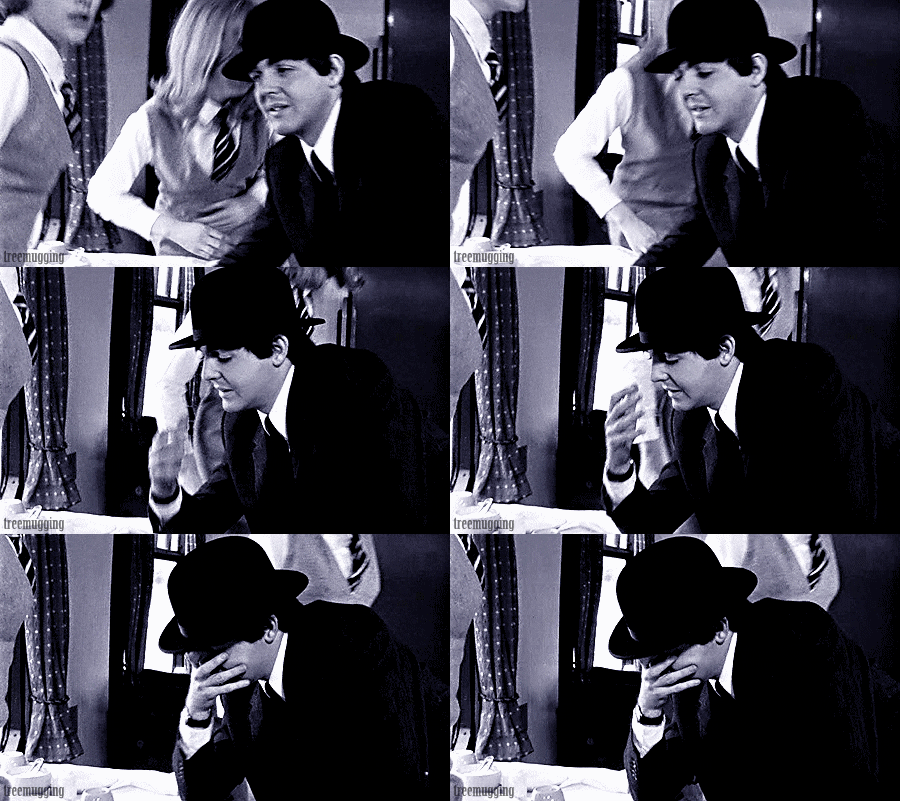
1964: The Beatles - The Beatles released "A Hard Days Night" and has a basic set out and is considered the beginning of contemporary music videos. This video had a narrative with fast paces cuts and had a variety of cinematography. It had set a new era of videos and artists began to come up with narratives to attract audiences. This was because The Beatles were the biggest music group at the time and were globally recognised.

1966-1968: The Monkees - The Monkees was a television show that aired for two years, every episode had a short film which was created to accompany songs made by the Monkees. This had helped create the fundamentals of today's music videos, especially for performance type music videos.


1966: The Birth of "Top of the Pops" - Top of the Pops was a television program created by the BBC and it's sole purpose was to promote singles of artists. Due to the limit the show had, artists were needed to compete in order to be aired, this meant only the most popular or famous and recognisable musicians were shown to audiences.

1967: Videos utilising cinematic techniques - The Beatles were seen to take initiate as they drastically changed the look of music videos. In their video for the song "Penny Lane" they used effects that were similar to cinema and high end film making. These elements included dramatic lighting. camera angles and rhythmic editing. This began the era of professionally edited music videos and film making which would accompany songs - this practice still occurs today. These new features further support Goodwin's theory of popular music videos.


1975: Queen, Bohemian Rhapsody - Bohemian Rhapsody was the first ever music video that was specifically made to replace live performances on TV. Despite previous videos that were made by the Beatles, Queen made videos with the sole purpose to be aired on TV, accompanied by their song. It was the very first video that was made on video format and had set an example for other artists that created music videos more frequently. The visuals had matched the song and there was very clear star image and genre characteristics, linking to Dyer and Goodwin respectively.


1981: MTV Launch and the development of music videos - As there was a very large supply of music videos at this point MTV was launched to support it. MTV caused more artists to air their music videos and people were able to see more of them, The Buggles released a video called "Video Killed The Radio Star" and it was the first ever music video to air on MTV. It was a high budget production and used overlay effects which was seen as complex editing.


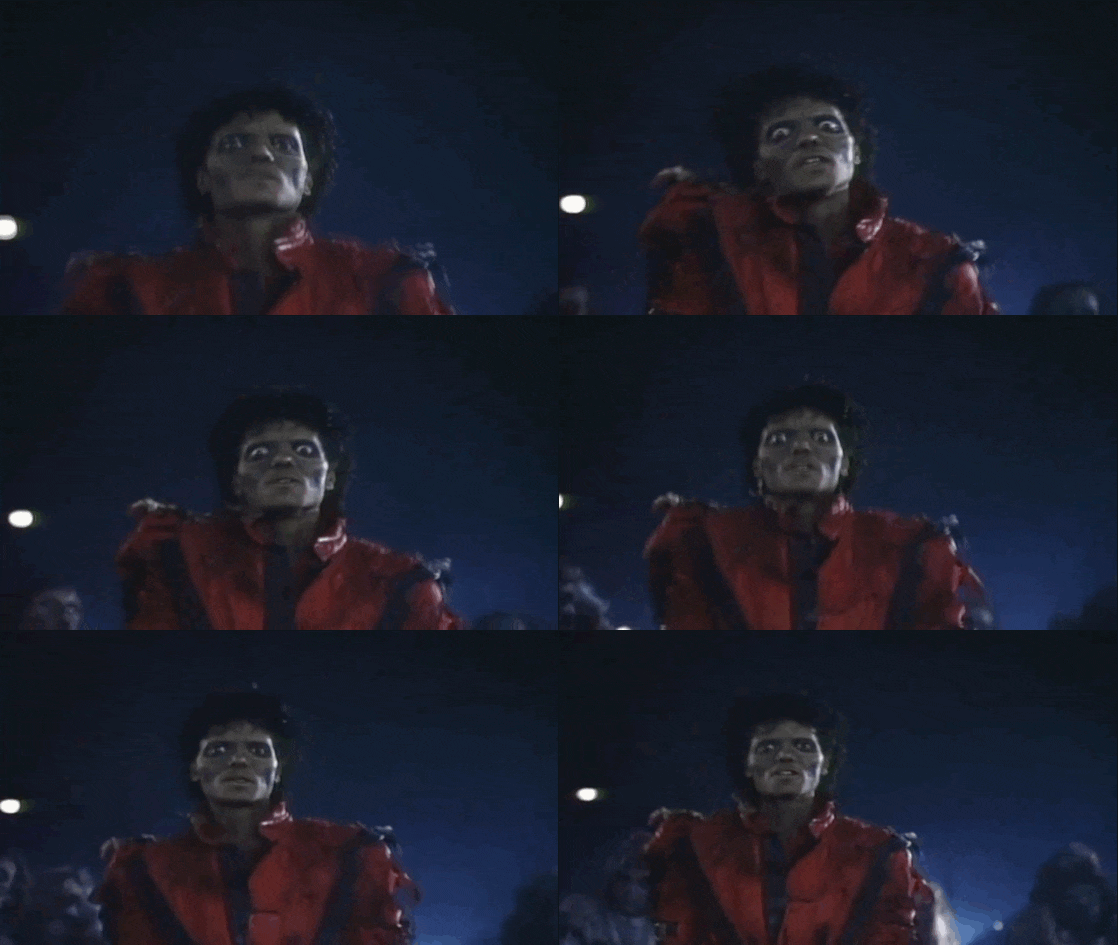
1984: Michael Jackson, Thriller. Michael Jackson's Thriller was seen as the birth of conceptual music videos, it had a clear beginning, middle and end and simulated a short film. It is still considered one of the best music videos ever made and around this time, Top of the Pops began to censor music videos and this is considered to be where censorship of music videos began. An example of this is Duran Duran's music video for Girls on Film was censored due to explicit content and promiscuity.


1980's: MTV and Music success. The 1980s saw the rise of the music video supply. Most artists made videos for their songs and they were debuted on MTV. Artists such as Madonna began to sell her music through politically and socially charged, controversial content which saw her gain global recognition and success. Many directors were then working on music videos, to eventually break into the film industry. An example of this would be Martin Scorsese, who is regarded as one of the greatest film directors of our time - entirely directed Michael Jackson's "Bad".

How have music videos developed over time?

Over time, music videos have greatly changed, this is due to the advancements in technology which has made it easy even for the smallest creators to make professional music videos. While big industries easily make large scale big budget music videos.


Technology/Equipment advancement: 

Technology has improved greatly and music videos are now very easily view able in HD and now 4K format as filming equipment has improved a lot. When music videos first started appearing frequently there were very few types of camera, this limited directors and artists to the way music videos would look. Artists today are able to edit their music videos professionally and have a lot of special effects due to editing software and green screen. Imagery can be created that can be compared to Hollywood large scale movies due to the technology available today, an example of this is Skrillex & Rick Ross - Purple Lamborghini which was made to simultaneously promote a single for the movie Suicide Squad. They used many special effects and expensive props and clearly spend a lot on costume, hair and makeup as some of the characters from the film appear in the video, and the film went on to win an academy award for Best Makeup and Hairstyling. Artists are also able to edit their sound a lot in professional studios.

The Distribution and Consumption:

Distribution and consumption of music videos have also developed over time. Various polysemy and synergy techniques are used to promote a video and now there are many different ways of distributing the videos and letting all people access them. Social media sites now make it very easy for music videos to be seen by all people with sites such as Facebook, Twitter, YouTube and Instagram have millions of users and are growing every day. Music videos are also aired on television channels such as 4Music and VIVA.

Star Image and Representation: 

Over time artists have undergone dramatic changes and performers portray themselves very differently in music videos. Although this does depend on the genre of the music video. For example, Hip Hop artists may try and boast about and glamourise their lifestyle and financial status by using expensive cars, large sets and expensive jewellery. An example of this is the artist Future who regularly does this in his music videos.

https://www.youtube.com/results?search_query=future

Purpose of music videos: 

A music video can have a myriad of purposes. Many artists create music videos simply for audience entertainment as their fans demand it. Other artists use it to enhance their career and gain recognition from the industry or audiences that do not know who they are. It can also be a good way of selling the artists music. Many modern music videos have gained controversy, due to the themes they portray and the content. An example of this is Robin Thicke's Blurred Lines, which was criticized for having lyrics that trivialize sexual consent, also the music video contained many women dancing around in the nude while the men in the music video were fully clothed. This can be seen as a technique for cheap publicity as the video was known globally for negative reasons but still benefited.

Conclusion:

After I extensively researched into the History of Music videos and the developments of the industry and technology as a whole which benefited music videos. I gained knowledge of the industry and have developed ideas on how to appeal to audiences with the technology I have available today . Although there is still debate on who created the first music video, I strongly believe it was Tony Bennett who created the first music video, this is because his video Strangers in Paradise contained the most obvious characteristics of a music video and can be linked to Dyer's Star Image and Goodwin's Theory of music videos. Researching into the history of music videos has allowed me to observe how music videos have developed over time and how the industry in constantly changing.

Saturday, 29 October 2016

Research: Channels

Music Channels


What are music channels and why are they important?

Music channels are dedicated TV channels that show only music videos by popular artists within the industry to the audience. This is vital to the industry as not only are the audience listening to the song, but they are also being exposed to the music video - this can lead to a larger a fan base. If music channels did not exist, exposure of music videos would not be as effective and artists would not be as successful. Although it can be argued with the introduction of YouTube and other social media platforms, it is not as difficult for artists to reach a wider audience with their music videos. Music video channels have a form of synergy with channels such as KISS and Magic having their own TV channels as well as radio stations allowing audiences to reach the music in different forms.

Music channels today

There are a large variety of music channels today, this is mainly due to the number of different genres there are therefore different audiences to appeal to.

Today's music channels include: Kiss, Flava, 4Music, Magic, Kerrang, The Vault, Bliss, Heart TV, Capital TV, Starz, Stars TV, Heat, MTV.


Are music channels the same as they were in the past?

Music channels no longer just cater for music video fans and audiences as they also show reality TV programmes due to larger audience appeal. MTV is an example of this, from being known to showing only music videos, to being one of the main music channels that show TV shows such as reality and drama - this is mainly because MTV cater to younger females ages 16-25.

MTV also has other channels on their network such as:

MTV Rocks - shows alternative rock music
MTV Classic - plays music from the 1960s to 1990s
MTV Base - plays Hip Hop, RnB and Rap
MTV Dance - dedicated to dance music

Examples of TV shows on MTV are Ex On The Beach, Catfish: The TV Show, Teen Wolf and Jersey Shore.


Image result for catfish the tv show                                   


What music genres are under represented and why?

Although there are more music genres than ever in the 21st century, some music genres are still under represented as they are niche genres and have a much smaller audience appeal, nevertheless fans of the genre. Alternative R&B and Hip-Hop are under represented genres - as their controversial content may put off networks from showing them, therefore they are only shown generally after 8pm to a small audience ranging from 18 to 30 years old.
Jazz music is also a genre that is seen to be under represented, although this is because Jazz mainly appeals to an older audience, aged 40 or older and they are unlikely to watch music channels but rather alternatives such as listen to the radio.
Grime music is a genre which is influenced by UK garage music but is also under represented as the genre might be seen as too niche or even inappropriate to be shown on major TV networks. Although there are smaller channels such as Channel AKA which show the music videos - YouTube is seen as the new and more effective platform for niche genres such as these. Music channels such as SB:TV and Link Up TV which focus of Grime and UK Rap are designed to promote these niche genres.

Advantages of the number of music channels

Promoting artists - Artists can get more recognition when played on music channels.
Creating a relationship between the artist and audience - This is done by the audience relating to the artist.
Establishing a fan base - Audience may recognise artists on music channels and the artist may establish a fan base this way.
Entertain audience - The audience have a large choice as to what to watch, they will therefore watch what entertain them.
Music industry growing - The music industry grows as the increase of music channels which allows them to play more advertisements and generate more income.
Artists earn more - As the music channels grow, artists get more air time and therefore more income.

Disadvantages of the number of music channels

Under representation - Many music channels may lead to very few artists getting the most recognition, leaving a lot of artists and genres under represented.
Less engagement and viewers - Music channels are not the most viewed TV channels therefore will not get as many viewers, this leads to audiences tuning in to watch TV shows, ultimately the networks playing more TV shows than music videos.
Less videos being played - Less music videos being played leads to less artist recognition which causes them to move to other platforms such as YouTube for their videos.

Conclusion: What music channels do you think your video will play on and why?

I believe my music video will be played on MTV as MTV is the most popular music channel, also it has many sister channels which can give my music video airtime. My music video may be for a song of a niche genre but it may get many views as MTV cater to most genres which leads to better recognition and eventually an established fan base. My music can also be played on radio channels as not everyone watches music channels for music videos, although if it is a niche genre, radio channels may not be appropriate.


Monday, 17 October 2016

Research: Popular Theory

Introduction:

There are multiple theories that can be applied to music videos, the most popular ones can be applied to general audiences and allow them to understand the music industry and why certain decisions are made when making music videos. Music video theorists are generally sociologists or psychologists and are very knowledgeable in their field making the theory effective. I researched, the 'Popular Culture' theory, Antonio Gramsci's theory of Hegemony, the Frankfurt school, Theodor Adorno's theory, the Birmingham school and Dick Hebdige's theory of subcultures.

Popular culture;

Popular culture relates to understanding the ideas of mainstream society to influence the society has on audiences. Popular culture was mainstream in the 80s and is mainly followed by working class citizens - known as "the masses". This is done through media such as music, arts, films and fashion which are all vital platforms for popular culture in today's society. In comparison to this, the middle class is said to follow "true art" who are seen to look down on the masses. This can be linked to the music industry and the promotion of artists and songs in particular ways, the masses simply take this on board and agree with it. Michael Jackson is an example of an artist that was highly regarded in the music industry and was labelled the "King of Pop" in the mainstream media and the masses therefore followed this and regarded him as the King of Pop, despite his death. This shows popular culture exists in society and in the music industry.

Theodor Adorno:

Theodor Adorno was a German sociologist and was known for his critical theory of society. Adorno suggests that popular music is usually divided into genres of music such as rock, pop, rap, heavy metal and reggae etc. Although, all popular music is standardised which are interchangeable from one song to another, and they all sing about the same types of lifestyles. The effects of standardisation are often hidden by "frills" that are put within a song to disguise that it sounds the same. Adorno also distinguishes between popular music and serious music, as serious music such as classical and avant-garde, plays to the pleasures of imagination which offers engagement. He also argues that popular music makes everyone think the same and that it is false, unnatural and immature. Whereas serious music is seen as deep, meaningful and natural, as those who follow popular music do not know what true art is, usually due to not having access to that type of content.


Frankfurt School:

The Frankfurt School were a group of German-American philosophers and sociologists who analysed the changes in Western capitalist societies that occurred since the classical theory of Marx. They proposed the Effects model which saw society to be composed of isolated individuals who were gullible to media messages, and visualised the media as a hypodermic syringe, suggesting that the contents of the media were injected into the thoughts of the audience, who accepted these attitudes, opinions and beliefs without questioning it, also highlighting the audience as purely passive. This was arguably also due to technology not being as developed as today, the media in general was heavily controlled by social elites back then and people had no platform or no choice at all to argue with the system in place. Prominent Frankfurt school theorists included, Max Horkheimer, Theodor Adorno and Herbert Marcuse. Horkheimer and Adorno focused on Hollywood as an example of conflict theory being used to enlighten and emancipate people. Hollywood was seen to produce profits by pumping out an endless stream of films, all with the aim to appeal to very similar audience, ensuring the viewer does not have to exert any mental energy to understand the film. The very small differences that came up in those films were simply put down to pseudo-individualism, this serves to mask the fact the style and form of films were identical to each others, small variations in plot or character were superficial imitations of individuality which masked the uniformity of all the products. Studios spend very large amounts of money promoting bigger and better films with a new brand, a new star with an underlying structural uniformity which the audience are not aware of.


Antonio Gramsci:

Antonio Gramsci was an Italian neo-marxist theorist and politician. He used the term 'hegemony' to denote the predominance of one social class over others. Dominant ideologies are considered hegemonic, power in society is maintained by constructing ideologies which tend to be promoted by the mass media. For example, the media is likely to control what is broadcasted to audiences, as well as what is censored and what is banned. As a result of this, musicians self publish their music and video on sites that are widely accessible, avoiding the mainstream media. It is argued that broadcasting companies do not hold hegemony anymore, although they attempt to regain it by using new technology, therefore the people hold hegemony. The mainstream media want us to believe in certain ideologies and this is done through media such as music and music videos.


Birmingham School:

Stuart Hall was a cultural theorist and sociologist who attended the Birmingham school and created a theory which revolved around issues regarding hegemony, he took a post-gramscian stance. He elaborated on encoding and decoding.

Encoding- the process by which a text is constructed by its producers
Decoding- the way in which an audience reads, understands and interprets a text, spectators will decode the text a different way.

Based on how music is interpreted for active audiences, producers are believed to be the bourgeoisie who encode messages within music and videos, this is evident through repetition in music and lyrics, although the way the working class receive and interpret the messages differ.


Dick Hebdige:

Dick Hebdige's main focus was on subcultures which are significant in the media industry. His argument was that consumption is an active process with differences in audiences' social and ideological construction which leads up to different readings of the same cultural products. The audience have a choice whether to resist the power of conglomerates and other large companies by finding alternative products to consume. This leads to the audience recognising themselves as different from mainstream culture, becoming subcultures. Hebdige also believes that companies attempt to stop resistance by creating products for subcultures also, this allows the audience to decide whether they should accept these products or resist them. Certain artists may also display subcultural values, usually through niche genre music which appeals to a subcultural audience. For example, Fall Out Boy are a rock band but most of their music is, pop rock, punk and emo pop. Therefore they appeal to the rock culture as well as the subcultures surrounding it.


Conclusion:

Each theory is significant individually due to the different viewpoints they have. Most of the theories are developed from the basis of Marxism and they all clarify societal divisions as well as in the music industry. Within these theories, the working class are primarily portrayed as not educated enough as they continue to absorb all the information being fed by the media and follow the popular culture. Whereas more middle class people or the bourgeoisie are seen as more intelligent and they follow true art which is influenced by their upbringing and differing hobbies from those who are working class.


Thursday, 13 October 2016

Research: Intertextuality

What is intertextuality?

Intertextuality in a music video is when there are references to other media within the video. Examples are past significant events, films or famous people. Artists may use intertextuality for many reasons, Goodwin also mentions intertextual references as a part of his theory as a key characteristic of music videos and this is evident in mainstream music videos, also is therefore a feature of a successful music video. Intertextual references impact the audience by generating a reaction from them, as audiences may base their opinions depending on the references and whether they enjoy them or not. Including intertextuality can benefit a music video as it can be entertaining for some audiences.

Examples of intertextual references


In this song "I Really Like You" by Carly Rae Jepsen, the star of the music video is a very well known Hollywood actor Tom Hanks, due to this there are intertextual references to his previous films. For example a man comes up to him and asks him to sign a table tennis bat, which is an intertextual reference to Tom Hanks' film Forrest Gump where he played a character who was skilled in table tennis.


In Eminem "Without Me", there are multiple references to comic books and super heroes such as Batman and Robin. For example when Eminem is shown putting on a costume he is wearing one very similar to the comic book character Robin. The whole concept of the music video is also that it is styled like a comic book.


George Michael "Outside" made many references to his own personal life. In the video a couple are caught in public toilets by the police which was a reference to his personal incident of being caught having sexual intercourse with a police officer and was subsequently arrested for it.


In the song "You Know Me" by Robbie Williams, the music video has various references to the fantasy world of Alice in Wonderland. The main artist is dressed as the character from the Alice in Wonderland franchise and is exploring the world and finishes by dancing with women dressed as rabbits, presumably other characters from the fantasy world.


In Taylor Swift - "Love Story" there are multiple intertextual references to William Shakespeare's Romeo and Juliet. The lyrics also support this and the two main characters are seen meeting at night presumably when they are not supposed to. Although the original story of Romeo and Juliet ends in tragedy, the music video has a happy ending with the couple together.


Why are intertextual references used and why might it appeal to a mass audience?

Intertextual references are used within music videos usually at the artist or directors choice, the artist may want to present a particular opinion as done with Taylor Swift - Love Song, where she changes the ending of a classic story to one she prefers. It is also done to create a response from an audience and and media critics, these references may generate a positive or negative reaction and may result in the audience enjoying the music video a lot more.

Criticisms of intertextual references

References may offend - Some intertextual references within videos may offend people. For example Eminem is an artist who regularly uses references without any limits, making fun of Michael Jackson's hair being caught on fire in Just Lose It. This may offend some who are watching or possibly those who are fans of Michael Jackson.

Influence opinion - References may also attempt to influence peoples opinion which does not allow the audience to generate their own opinions and have a genuine reaction to a music video. For example a larger more popular artist might influence a fan bases opinion on a less popular artist, influencing their opinion on the less popular artist. An example of this is the recent feud between artists Drake and Meek Mill, both of whom wrote and recorded 'diss tracks' aimed toward each other but Drake has a much larger fan base and was able to influence a lot more peoples opinions.

May spread negativity - Some references could spread negativity as not every artist has references that have a positive message.

References may be controversial - References, especially those of political opinions or opinions on current events can be very controversial. For example if an artist is anti-war and regularly makes intertextual references about wars and poses the opinion against war, those who are pro-war may dislike the artist due to their views.

May lead to an artist losing fans - References could cause artists to lose fans if they find the intertextual references inappropriate, they may not support the artist and their music any further due to this.

Will you use intertextual references in your music video?

After my research into intertextual references I have learned that I have to be very specific and choose my references carefully if I am going to do so. Due to this I will most likely not include any intertextual references, but if i am able to during the process, I will make sure the reference does not have any negative connotations and will not result in my artist losing any fans, or influencing opinions.

Tuesday, 11 October 2016

Research: Mulvey’s Male Gaze

Mulvey's Male Gaze

Introduction:

Laura Mulvey is a British feminist film critic. In 1975 she came up with the theory of The Male Gaze - film viewers view characters from the perspective of a heterosexual male. Cameras linger on the curves of the female body, specifically breasts and bottom, this demeans women to the status of objects, almost viewing them as props.

There are three ways in which feminists see this theory:

1) How men look at women
2) How women look at themselves
3) How women look at other women


Mulvey's Male Gaze:

There are many features of Mulvey's male gaze theory, it revolves around the idea that what we see on screen is from a heterosexual male's perspective. This is because the camera lingers on female's body parts and are presented largely in the context of a man's reaction to these events. The male gaze suggests that women should look sexually appealing, as shown through various mid shots and close ups. This can also be linked to a patriarchal society as masculine individuals or organisations exert their power to determine what is"natural" - which eventually creates levels of inferiority.

Examples:


Artist drake presented as a wealthy dominant male, with stereotypes of males drinking being shown as he is surrounded by empty champagne glasses. He is wearing jewellery and is presumably in an expensive home. His gaze is straight at the camera which asserts dominance as he wants to be the focal point of the situation.


Rihanna is presented wearing less clothing as her shoulders are exposed. Unlike most male artists she is not looking directly at the camera, she is looking away; almost as if she is exposed or vulnerable.
In this video there are multiple women wearing very minimal clothing. This video when it was released caused a lot of controversy due to the lyrics. However, this video can be interpreted differently by different people. Some might argue that the women in the video are being objectified, almost seen as props for the video as they are near nude and the men are fully clothed from top to bottom. Others may argue that the women are taking control as they are comfortable in their bodies and are therefore empowering themselves, the men are shown to be brushing their hair while they dance around and the females directly look at the camera at some points, asserting their dominance over the male actors.


In the video for "Wrecking Ball" by Miley Cyrus she is presented as naked for the majority of the video, although this may be interpreted as an empowering position for a young woman, as she is not being objectified by males which could be considered as the unfortunate norm in the music video industry.


In French Montana's "Pop That" the majority of women are all wearing minimal clothing, walking around and dancing with bikinis. This is contrasted to the males who are fully clothed. Mulvey's gaze can be applied to this as there is focus on the women's breasts and buttocks. The males are portrayed as having ultimate control as the women are seen as props and the women are simply there just to please the males. 

Criticisms:

Mulvey suggests that the characters we see are through the perspective of a heterosexual male. This does not include the view of bisexual male or homosexual female audiences who may also enjoy watching female assets.

Does not consider all women, as all women are different. Not every woman is promiscuous and objectified, the theory considers these women as lacking respect for themselves. The women in music videos are usually models or other artists.

Mulvey's theory only takes into consideration the gazing of women's assets but not males. Despite it being rarely identified, male's assets can also be gazed upon.

The theory does not consider people's own opinions whether they enjoy being looked at or not. Some females may be proud of their bodies and see it rather as a compliment than objectification when being gazed upon. If women in music videos were uncomfortable by the way they were being portrayed in the video,

Mulvey's theory of the male gaze is a significant theory in the modern age, especially due to the feminism movement. It is obvious that there are women that are being seen as sex objects and this being promoted highly by the rap and hip hop genre, and this can be centered around Mulvey's theory of male gaze. As well as this, the genre of rap and hip hop is constantly growing and there is an increase in the number of videos that contain women wearing less clothing and revealing assets. Despite this, some women may see this as empowering rather than seeing themselves as being objectified.

In conclusion, due to how relevant Muley's theory of the male gaze is today and as I will be making a video based on the Rap/Hip-hop genre, I will be implementing the theory in my music video. I will not be asking female actresses to appear in my music video but if they are, they will be fully clothed and my camera shots will not linger on their assets. I see this as a shift from the stereotypical norm of a rap or hip hop music video, thereby making my video appeal to niche audiences but still have the general pleasure of a rap or hiphop music video.